Sunday, September 27, 2009

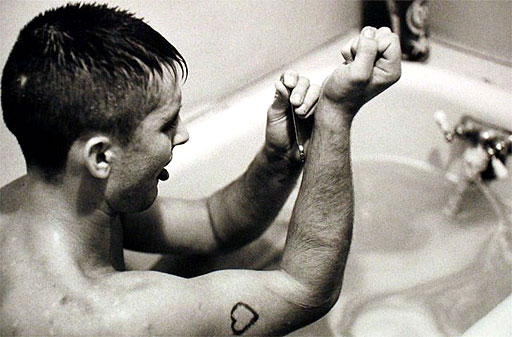
Monday Entry - Harmony Korine

Harmony Korine is an American film directer, producer, screenwriter and author best known for his screenplay Kids and for directing the movies Gummo, Julien Donkey-Boy, and Mister Lonely.


Website


Thursday, September 24, 2009

Thursday Entry - Eucharist

The name given to the Blessed Sacrament of the Altar in its twofold aspect of sacrament and Sacrifice of Mass, and in which Jesus Christ is truly present under the bread and wine.

"Christ held Himself in His hands when He gave His Body to His disciples saying: 'This is My Body.' No one partakes of this Flesh before he has adored it."

- St. Augustine


Kreeft, Peter. Nichols, Aidan. Vonier, Abbot. A Key to the Doctrine of the Eucharist. Zaccheus Press, 2003. Written to give lay Catholics a better understanding of the Eucharist, this book is recognized as a modern spiritual classic. In remarkably clear and straightforward language, it takes the reader step-by-step into the deepest mysteries of the Eucharist — a religiously exhilirating journey into the heart of the Christian faith.

I looking at Catholic ritual in relation to my work and the narrative I am creating.


Tuesday, September 22, 2009

Artist Lecture: Sonya Clark


Sonya Clark is the Chair of the Craft and Material Studies department at VCU. She began her lecture by conversing with the class and explaining the reasoning behind the materials she works with, particularly how textile and fabric are most omnipresent in craft.

I was especially interested in her work with human hair; she explained that hair is form of identity, both in its depiction of the passage of time as well as containing our DNA. DNA plays a role in her work with other materials as well, for instance her chromosome details made of beads. In fact, one can see her concepts interwoven throughout her portfolio, such as in her silk-screened fingerprints and structures made with black plastic combs. She also sometimes aesthetically combines pieces from separate series, such as taking from her "Hands" and "Roots" series and creating a beaded hand with roots.

Her materials correspond specifically with her concepts, the importance of which she stressed. She also emphasized the ubiquity of textiles; while some of her work employs other materials, such as beads and copper, I found myself most drawn to those made with textiles (the Hair series and the thumb print silk-screens in particular). The piece "Hair Wreath," made of human hair and wire, was especially intriguing to me as it reminded me of a crown of thorns.

Though I have done very little in terms of craft and material work, I have always been interested in mixed media and hearing artists discuss the reasoning behind their chosen media. This, as well as the intrigue of seeing work in a medium I'm not as familiar with, made Sonya Clark's lecture particularly enjoyable.

Monday, September 21, 2009

Monday Entry - Chris Weeks


Chris Weeks is a freelance editorial photographer based in L.A. His work is published regularly in many wide circulation magazines, such as Vogue and Rolling Stone. The majority of his work is done outside of a studio setting.

Website
Interview
Publications

9/14 Blog Evaluation

Paul Thulin has read your blog up to this point/entry. Your blog is currently up to date and complete.

Wednesday, September 16, 2009

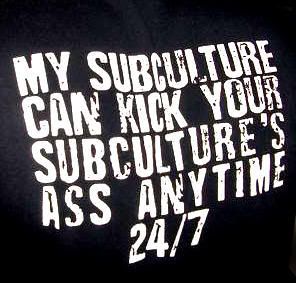
Thursday Entry - Subculture

1 a : a culture (as of bacteria) derived from another culture b : an act or instance of producing a subculture
2 : an ethnic, regional, economic, or social group exhibiting characteristic patterns of behavior sufficient to distinguish it from others within an embracing culture or society

Greenberg, Arielle. Youth Subcultures: Exploring Underground America. California: Longman, 2006. Youth Subcultures by Arielle Greenberg uses a cultural studies lens to explore contemporary American youth subcultures such as skateboarding, punk, Goth, and raves.

"In any culture, subculture, or family in which belief is valued above thought, and self-surrender is valued above self-expression, and conformity is valued above integrity, those who preserve their self-esteem are likely to be heroic exceptions" Nathaniel Branden


I was surprised when Kenney began throwing around words like "punk" in relation to my work, because I'd never really considered the connection. But I quickly realized his point; for example, one of my stills of a man bloodied up in a bathroom is very reminiscent of Sid Vicious. My settings are dingy and reflect lifestyles evocative of subcultures of wasted youth. We discussed the myriad connections between subculture and religion and I am considering these more as I hone in on a more specific concept.

Monday, September 14, 2009

Monday Entry - Larry Clark


Larry Clark (1943 - ) is an American film director, photography, writer and producer. His work most often includes American youth engaged in various illicit activities, such as drug use and promiscuous sex. He is probably best known for his film Kids.

Website

Gallery

Interview

"LC: No. I was still out there living the life. I was a full-fledged alcoholic and drug addict by then, and all I wanted was drugs. I had girlfriends who could get me drugs and prostitutes who could get me drugs; I just happened to have my camera that I would be able to raise now and again to make photographs with."

Thursday, September 10, 2009

Thursday Entry - Iconography

1 : pictorial material relating to or illustrating a subject
2 : the traditional or conventional images or symbols associated with a subject and especially a religious or legendary subject
3 : the imagery or symbolism of a work of art, an artist, or a body of art

Van Straten, Roe. An Introduction to Iconography: Symbols, Allusions and Meaning in the Visual Arts. Overseas Publishers Association: Nevada, 1994. An Introduction to Iconography explains the ways that artists use references and allusions to create meaning. The book presents the historical, theoretical, and practical aspects of iconography and ICONCLASS, the comprehensive iconographical indexing system developed by Henri van de Waal

"The figure in the icon is not meant to represent literally what Peter or John or any of the apostles looked like, or what Mary looked like, nor the child, Jesus. But, the orthodox painter feels, Jesus of Nazareth did not walk around Galilee faceless. The icon of Jesus may not look like the man Jesus two thousand years ago, but it represents some quality of Jesus, or his mother, or his followers, and so becomes an open window through which we can be given a new glimpse of the love of God. " - Madeleine L'Engle

"In their simplicity and directness [neon signage is] a kind of urban iconography with which we can identify on many levels." — Rudi Stern

My obsession with religious iconography is obvious, but in my quest to turn from using obvious symbols and begin using religion more abstractly I am finding comparisons in modern iconography. For example, Joe Strummer as a Christ figure.


Monday, September 7, 2009

Monday Entry - Glen Baxter


Major exhibitions of Glen Baxter’s drawings and paintings have been held in New York, Paris, San Francisco, London, Munich, Tokyo and Sydney. In 1999 Baxter was commissioned by the French government to execute a tapestry. He has also worked on a series of etchings for the National Museum of Printmaking in Chatou, Paris. His work is in the collections of the Tate Gallery and V&A Museum in London and numerous museums and private collections around the world.

Website

Gallery

Interview

I have this weird love of mixing childlike imagery with adult themes, which Glen Baxter does with the added bonus of his bizarre captioning. There is also a tiny image on his website of a book titled "Tofu Walk with Me," which I am immensely intrigued by. Bean curd and David Lynch?

Wednesday, September 2, 2009

Thursday Entry - Stream of Consciousness

Stream of consciousness refers to the flow of thoughts in the conscious mind. The full range of thoughts that one can be aware of can form the content of this stream, not just verbal thoughts. Commonly used experimental techniques, including self-reporting, gives easier access to verbal thoughts than to thoughts more closely connected to senses other than hearing and activities other than speaking and writing.

"Within each personal consciousness, thought is sensibly continuous. I can only define 'continuous' as that which is without breach, crack, or division. The only breaches that can well be conceived to occur within the limits of a single mind would either be interruptions, time-gaps during which the consciousness went out; or they would be breaks in the content of the thought, so abrupt that what followed had no connection whatever with what went before. The proposition that consciousness feels continuous, means two things:

a. That even where there is a time-gap the consciousness after it feels as if it belonged together with the consciousness before it, as another part of the same self;

b. That the changes from one moment to another in the quality of the consciousness are never absolutely abrupt" - William Blake, from his essay The Stream of Consciousness (1892)


Dainton, Barry. Stream of Consciousness Unity and Continuity in Conscious Experience. New York: Routledge, 2000.

"
Although there has been a massive upsurge of interest recently in consciousness, most of this has been focused on the relationship between consciousness and the brain. This has meant that important and intriguing questions concerning the fundamental characteristics of consciousness itself have not received the attention they deserve. Stream of Consciousness is devoted to these questions, presenting a systematic, phenomenological inquiry into the most general features of conscious life: the nature of awareness, introspection, phenomenal space and time-consciousness." (from Amazon.com)

Stream of consciousness relates to my work in a variety of ways, but primarily in that it is almost always the way artistic motivation comes to me: when I just write without structure or any defined intent, or simply lay with my eyes closed and allow my thoughts to roam with as little focus as possible. Also, whenever I work with mixed media, in the first stages I like to work impulsively, letting my hand work as quickly as my the thought comes to my mind.


"As described in Figure 7, pre-reduction quantum computation is suggested to correlate with pre-conscious processing, and the objective reduction process itself to a conscious moment. A series of such moments can give rise to a stream of consciousness." (Quantumconsciousness.org)