Monday, December 8, 2008

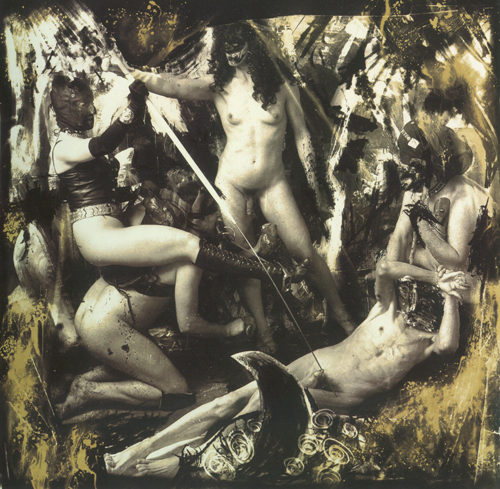
Andres Serrano (Make up 4)


Andres Serrano (1950 - ) is an American photographer who is most well-known for his photograph "Piss Christ," which depicts a crucifix submerged in urine and blood. Much of his work is controversial due to its incorporation of religious iconography in sordid environments, though Serrano himself does not see his work as sacrilegious. His work has been exhibited worldwide since 1984.

http://www.communityarts.net/readingroom/archivefiles/2002/09/shooting_the_kl.php (Interview)

http://www.corcoran.org/collection/highlights_main_results.asp?ID=80 (Gallery)

http://andresserrano.org/ (Wesbite)

Bible Codes (Make up 3)

Meaningless (or ambiguity of meaning)

"The Torah codes debate forces us to face this issue squarely. There are those who assert that it has been statistically proven that there are codes in the Torah so it can be used as a first step to get some non-religious Jews to start thinking seriously about yiddishkeit. But the virtually unanimous opinion of those professional mathematicians and statisticians who have carefully examined the evidence is that there has been no scientific proof of the codes." - Barry Simon (Professor)

Drosnin, Michael. The Bible Code. New York: Touchstone Publishing, 1998.

The concept of hidden codes in the bible, no matter how much apparent scientific/mathematic research is applied, is ridiculous to me. But the idea of taking a religious text and extracting a new meaning and using it for one's own intentions is something I can completely relate to. Just as I am taking my own experience of the bible and treating it with tinges of irreverence and irony through artistic expression, those who study bible code are taking the religious text and using it to express their own ideas (ideas which they claim surface from pages of the bible). And just as I find it to be an absurd, pointless endeavor, it is most likely that any person working in such a field would find my work absurd and pointless. It is the root of it that I find interesting (the bible as source material) and the bizarre spectrum of expression it has wrought.


Sexual Deviance (Make up 2)

Exploratory

"As we have seen, sexual deviance can be approached in at least four ways:

• It may be ridiculed as a personal quirk (as in the strictly heterosexual Siwan male),

• it may be condemned as a sign of immorality (as in the orgasmic Victorian woman),

• it may be punished as a crime (as in the homosexual Rwala Bedouin),

• it may be treated as a disease or disorder (as in the nonorgasmic modern woman)."

- Erwin J. Haeberle (Sexologist)


"The only unnatural sex is that which you cannot perform." - Alfred Kinsey (Sex Researcher)

Laws, Richard. O'Donohue, William. Sexual Deviance: Theory, Assessment, and Treatment. New York: The Guilford Press, 2008.

My work explores sexual deviancy, mostly in the vein of the inherent guilt of sexual feeling as a Catholic or someone who was raised Catholic. Even if a sex act is considered "normal" by modern standards, it is unavoidably deviant when viewed through a religious lens. Investigating these boundaries has become a fairly regular component in my work.


White Noise (Make up 1)

White noise is a random signal (or process) with a flat power spectral density. In other words, the signal contains equal power within a fixed bandwidth at any center frequency. White noise draws its name from white light in which the power spectral density of the light is distributed over the visible band in such a way that the eye's three color receptors (cones) are approximately equally stimulated.

Abstract

"On one hand white noise is a very simple process: it is stationary centered Gaussian, and it is independent at different moments of time. The combination of these properties singles it out as a natural object to start from: in a sense, white noise is a "universal" source of randomness, and as such it appears in many fields of applications." -
Takeyuki Hida (Mathematician)

Kuo, Hui-Hsiung. White Noise Distribution Theory (Probability and Stochastics Series). CRC Press, 1996.

White noise is essentially the aural equivalent of the layer of visual discord I incorporate in my imagery.

http://whitenoisemp3s.com/free-white-noise


Sunday, November 16, 2008

Incomplete

Paul Thulin has read your blog up to this point/entry. Your blog is currently not up to date and work has been recorded as incomplete.

Erica Shires


Erica Shires is an American photographer who received her BFA at Pratt Institute. She's been a professional photographer for three years. The image of hers that caught my eye looks to be a digital film still, an aesthetic I've taken a particular interest in, and I recently looked up more of her work. I haven't looked at many new artists, especially not photographers, because there is such a vast sea of commercial photography I am uninterested in sifting through. However, I was very drawn to many of the photographs on her site and occasionally saw similarities in her subject matter and my own.

http://www.ericashires.com (Website)

http://www.commarts.com/fresh/erica-shires.html (Interview)

http://www.heartgallerynyc.org/core/Photographers/ (Gallery)

Sunday, November 9, 2008

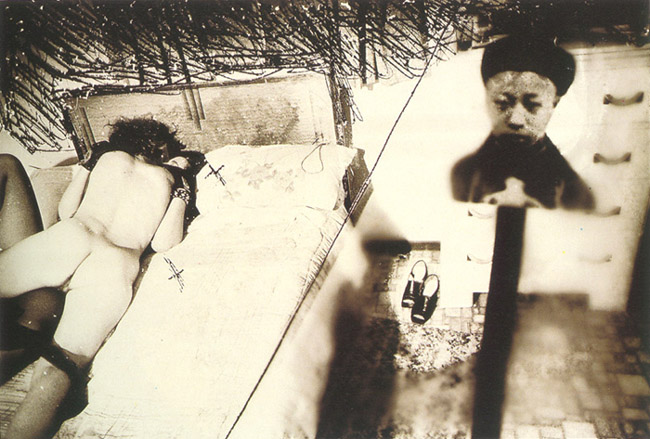
Robert Heinecken


Robert Heinecken (1931 - 2006) was an American artist whose work primarily dealt with appropriating contemporary media imagery and often juxtaposing it with photography. Though often put into the realm of photography, he never even used a camera until the late 70s and even then it was to take Polaroid images of magazines. His work was very controversial, especially within the feminist movement. He was also an honored professor and his work has been exhibited worldwide.

http://heinecken.org/ (Website)

http://www.fnewsmagazine.com/2007-feb/humorous-warfare-&-hypocritical-misogyny.php (Review)

http://rhoffmangallery.com.19.m6.net/exhibition.asp?exid=384 (Gallery)

Sunday, November 2, 2008

Kenneth Anger

Kenneth Anger is an American underground film-maker, born in 1927. He began making films at age nine, but never had any formal training. The only schooling he had, apparently, was attending a dance school with Shirley Temple. He was close friends with Alfred Kinsey, helped him build his film archive and appeared in some of his research films.

Anger had an obsession with the occult which is very apparent in his films. Scorpio Rising (1963) is the film that initially drew me to Anger. I was floored; it included the fusion of three things I am endlessly interested in - religion, sexuality, and 50s/60s pop music. For a film about a Nazi bike gang, homoeroticism, drug use and Satanic rituals, it was incredibly subversive for its time.

http://video.google.com/videoplay?docid=-4704748884284449320 (Scorpio Rising)

http://www.ratso.net/anger.html (Interview)

http://www.sensesofcinema.com/contents/directors/03/anger.html (Website)

There is no gallery representing Anger, but surprisingly, most of his films can be found on Google video and YouTube.

Thursday, October 30, 2008

Revelation

Intrigue

Revelation (also, Apocalypse of John): the last book of the Christian bible, composed entirely of apocalyptic literature.

"An attempt to describe a spiritual reality and heavenly worship." - St. Augustine

I attended Sunday school for fourteen years and Catholic mass for several years after that. The only time the Book of Revelation was ever addressed was in a sermon one Sunday when the priest told us that being interested in Revelation meant you were turning away from Jesus and essentially, you were a bad Christian. I never really understand what it was about, aside from a a vast a vague concept of the end of the world. I wanted quite badly to learn more, but the priest made it seem as though concerning yourself at all with it was the equivalent of taking fruit from the Tree of Knowledge. And this sermon came at an age when I prayed immediately after accidentally saying the Lord's name in vain.

So now, as I explore these new boundaries and regularly take bites of forbidden fruit with no apologetic prayers, I am trying to make work which incorporates these discoveries.

Thursday, October 23, 2008

London

Freedom

On New Year's Day of 2008, I set off with a friend for London with a single backpack filled with little more than clothes, books, and a new journal. We had no itinerary; we did not know necessarily where we would be sleeping that night. I had never left the country before.

When we touched down in Heathrow, we immediately ran for any exit we could find, so desperate for a cure for our nicotine withdrawal. I had never felt anything like when we burst out of the doors, dead tired but never more excited, and stared out at a whole new continent.

"Have you ever felt this free in your entire life?"

The experience of ten days of uninhibited exploration was life-changing. It is hard to describe succinctly the way it affects my work, but I think the raw power of taking on something completely new with only a small understanding of where you're going is a feeling I look to for inspiration and also desperately want to capture. I want that feeling when looking at a blank canvas or at the start of a new roll of film as much as I want to find a way to express it.

Tuesday, October 21, 2008

Incomplete

Paul Thulin has read your blog up to this point/entry. Your blog is currently not up to date and work has been recorded as incomplete.


- Thursday 10/16 entry missing


- missing 2nd September Lecture

Sunday, October 19, 2008

Joel Peter Witkin


Joel Peter Witkin is an American photographer, born in 1939. From 1961 to 1964 he worked as a photographer in the Vietnam war. After receiving his BFA he began to focus more on his fine art work.

To describe his photography as morbid is an understatement. It is horrifying, eye-opening, and beautiful in a bizarre, inexplicable way, all of which is enhanced by the daguerreotype quality in his images. He cites this experience as part of what shaped his vision:

"It happened on a Sunday when my mother was escorting my twin brother and me down the steps of the tenement where we lived. We were going to church. While walking down the hallway to the entrance of the building, we heard an incredible crash mixed with screaming and cries for help. The accident involved three cars, all with families in them. Somehow, in the confusion, I was no longer holding my mother's hand. At the place where I stood at the curb, I could see something rolling from one of the overturned cars. It stopped at the curb where I stood. It was the head of a little girl. I bent down to touch the face, to speak to it -- but before I could touch it someone carried me away."

What initially drew me to his work was his use of religious icons in a manner previously unknown to me. That he found it necessary to include that it was a Sunday and he was on his way to church when this incident occurred provides an interesting insight into his images. There is also the fact that his parents divorced when he was a young boy - his father was Jewish while his mother was Roman Catholic and they could not reconcile their religious differences. He has also said, "I consider myself a Western Christian artist, and the basis that I hang all this stuff on is belief. "

http://www.cindymarlerphotography.com/Witkin%20text.html (Interview)

http://www.edelmangallery.com/witkin.htm (Gallery)

http://www.correnticalde.com/joelpeterwitkin/ (Website)

Saturday, October 11, 2008

William J. Schaff Jr.

William J. Schaff Jr. in an American artist born in 1973. He is a musician and visual artist who works in a variety of mediums. He has created album artwork for several bands, including every release by Okkervil River on Jagjaguwar records. He graduated from the Maryland Institute College of Art. He currently resides in Providence, Rhode Island.


http://www.flickr.com/photos/samsa1973/ (Website)

http://galleryagniel.com/home.php (Gallery)

http://www.austinchronicle.com/gyrobase/Issue/story?oid=264983 (Interview)

Sunday, October 5, 2008

Todd Hido

Todd Hido is an American photographer born in Kent, Ohio. He received his BFA at Tufts University in 1991 and his MFA at the California College of Arts and Crafts in 1996, along with a wealth of visual arts awards during his collegiate career. His work has been exhibited in a variety of galleries worldwide since 1993. He creates beautiful, ethereal imagery, mostly of houses at night and landscapes, using only available light. He also photographs interiors, sometimes creating portraiture by including women in the setting.


http://www.popphoto.com/photographynewswire/3879/lies-leading-to-truth.html (Interview)

http://www.wirtzgallery.com/exhibitions/2001/exhibitions_2001_07/exhibitions_th_2001_07.html (Gallery)

http://www.toddhido.com/ (Website)

Thursday, October 2, 2008

Eroticism

Aesthetic or literary focus on sexual desire.

Anticipation.

"Man goes constantly in fear of himself. His erotic urges terrify him." - Georges Bataille, writer/philosopher

Mahon, Alyce. Eroticism and Art. New York: Oxford University Press, Inc., 2005. Alyce Mahon focuses primarily on the last 150 years of art and the debates surrounding erotica. The book explores the ideas surrounding the boundaries between art and pornography.


I have very mixed feelings about the word "erotic." The internet is likely to blame for this, but when I hear the word I immediately think of cheap vinyl costumes, black lipstick and bad photography. I am not interested in photographs which are only meant to serve to purpose of arousal. It all strikes me as cliche and boring. But put in a different context, eroticism can be very interesting. And there are so many facets to it that it might have nothing to do, in the end, with stirring sexual response.

I would never describe my work at erotic. There is no intent on my part to create images for the purpose of base sexual thought. However, it'd be a lie to say sexuality does not play a part in much of my work. I have become fixated on creating work which deals with my Catholic upbringing, primarily the struggle it created at puberty. But approaching, discussing, and dealing with sexuality through artwork is on a whole different plane than creating images which, to put it bluntly, get people off. I wish to continue exploring those lines.

Monday, September 29, 2008

Candice Breitz

After hearing a verbal overview of Candice Breitz's work in class, I was very intrigued and excited about attending her lecture.  Her own descriptions of her work were nearly as fascinating as actually viewing the pieces.  I tried to scribble down quotes as much as possible, since her language was so vivid and interesting.  For example, she described pop culture as a "perverse, ominous collective archive," later saying her work was meant to "operate as a virus from within that shared archive."  It struck me as such a beautiful way to describe an already incredibly captivating body of work.

She discussed the audience/celebrity relationship and how one cannot exist without the other.  Her work taps into our vast pop culture and pulls something out of it which is ultimately worth more than the media she is drawing from.  Though the experience of viewing the Babel Series is undoubtedly more powerful in the gallery setting it is meant for, I was still quite entranced by it in the small clips she provided for us in the lecture.  What I was most affected by, however, was the Mother + Father series.  We only viewed Mother, though I watched Father on my own later.  It gave me a great deal to consider, not only of the media's interpretation of parenthood, but of my relationships with my own parents.   Overall, the combination of viewing her work and hearing her wonderful use of language in discussing her artistic intent was a singular and incredibly interesting experience.  I hope to one day view her work in a gallery and gain the full effect. 

Cy Twombly


Cy Twombly (1928 - ) is an American artist best known for his large scale, abstract works incorporating both drawing and painting.  He also occasionally incorporates text in sprawling cursive.  His first solo exhibition was held in Kootz Gallery in 1951 and his work has since been exhibited around the world.  A collection of his work was recently on exhibit at the Tate Modern.  He currently lives in Lexington and Italy. 

http://www.guardian.co.uk/artanddesign/2008/jun/03/art1   (Interview)

http://www.gagosian.com/artists/cy-twombly/exhibitions  (Gallery)

http://www.menil.org/twombly.html  (Website)


I had the very fortunate experience of viewing Twombly's "Seasons" at the Tate Modern in January of 2008.  It was an awe-inspiring moment and I had a difficult time tearing myself away.  The stream of consciousness element of his work both fascinates and inspires me. 

Apparently, years ago, a young Frenchwoman visited a gallery which displayed his painting "Say Goodbye, Catullus, to the Shores of Asia Minor" and was found staring at it, completely naked.  She was discovered and told to dress herself, but before leaving she wrote in the guest book, "The painting makes me want to run naked."

Sunday, September 28, 2008

Incomplete

Paul Thulin has read your blog up to this point/entry. Your blog is currently not up to date and work has been recorded as incomplete.


Sunday Artist Highlight

Breitz Lecture Review

Wednesday, September 24, 2008

Catholicism

"Catholicism is not a soothing religion. It's a painful religion. We're all gluttons for punishment."
- Madonna Ciconne, Author

Mcbrien, Richard. The Church: The Evolution of Catholicism. New York: HarperCollins, 2008. The Church: The Evolution of Catholicism details the history of the Catholic Church from its conception to its current standing in society.

I have realized that my work, despite the likelihood that it would offend devout Catholics, still has an element which almost reveres the religion I've completely rejected. It is so ingrained in me that it's nearly inescapable. The struggle I find with my work, currently, is finding the voice which coherently deals with the subject matter I am so inherently fascinated with.

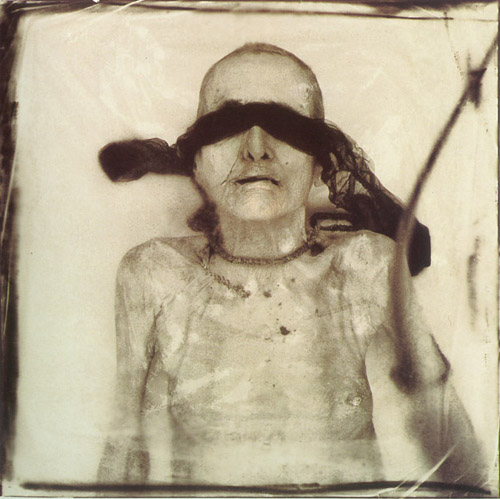
The Naked Follow the Naked Christ by Joel Peter Witkin

Sunday, September 21, 2008

Incomplete

Paul Thulin has read your blog up to this point/entry. Your blog is currently not up to date and work has been recorded as incomplete.

missed thursday 9/18 entry

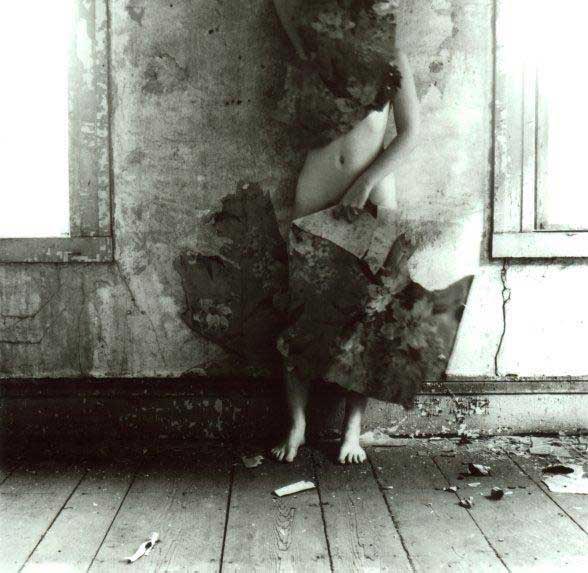
Francesca Woodman

Francesca Woodman (1958 - 1981) was an American photographer who worked mostly with female models, including herself, and low shutter speeds. Often the women are anonymous and blend to some extent into their surroundings. She attended the Rhode Island School of Design. Though her work gained little attention during her short life, they have garnered much appreciation after her death. She created around 10,000 negatives (which her family now owns) and of approximately 800 prints, only 120 have ever been exhibited. She committed suicide at the age of 22.


http://www.victoria-miro.com/artists/21,biog/ (Review)

http://www.heenan.net/woodman/ (Website)

http://www.tate.org.uk/collections/artist-rooms/francesca-woodman.shtm (Gallery)

Monday, September 15, 2008

Robert Rauschenberg

Robert Rauschenberg was born on October 22, 1925 and died on March 12, 2008. He was a mixed media artist who commonly employed the use of found objects. He is best known for his work in 1950s, in the era of abstract expressionism and pop art. Elements of each of these movements can be seen in his work.


http://jasonkaufman.com/articles/robert_rauschenberg_at_72.htm (Interview)

http://www.guggenheimcollection.org/site/artist_bio_133.html (Gallery)

http://www.artchive.com/artchive/R/rauschenbergbio.html (Website [could not find a more official one]


"People ask me, 'Don't you ever run out of ideas?' In the first place I don't use ideas. Every time I have an idea it's too limiting, and usually turns out to be a disappointment. But I haven't run out of curiosity."

Wednesday, September 10, 2008

Mixed Media

"I discovered the wealth of exotic papers available on the market for artistic uses and began using imported papers to create the abstracted atmospheric backgrounds for my figures. This opened up a new world of communication for me, in that the ready-made papers already have a tone and a mood that I respond to. Mixing mediums is the most thrilling and adventuresome type of art, because you get many unexpected surprises of color and texture. Every time you add something new to a collage it reassembles itself and responds back. It’s a conversation between artist and art." - Susan Krieg

Perrella, Lynne. Art Making, Collections, and Obsessions: An Intimate Exploration of the Mixed-Media Work and Collections of 35 Artists. Massachusetts: Quarry Books, 2007.

I have become increasingly interested in working with mixed media. I've experimented with wood panel, paint, ink, and paper and would like to continue working with new materials while incorporating photography.

Sunday, September 7, 2008

Complete

Paul Thulin has read your blog up to this point/entry. Your blog is currently up to date and complete.

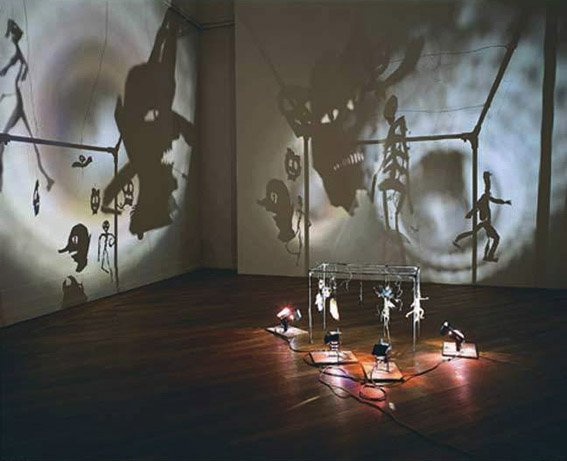
Christian Boltanski

Christian Boltanski is a French photographer, sculptor, painter and installation artist who was born in 1944 in Paris. He stopped his formal education at age twelve and began to immerse himself in creating art, particularly painting and drawing. As he got older, his work became more mixed media and intallation. The Tate museum website quotes that his work uses "the ephemera of the human experience, from obituary photographs to rusted biscuit tins." He commonly uses found photographs and relies heavily on lights in the exhibition of his work. Around 60% of his work is destroyed after shows. His work has been exhibited internationally since the 1970s.


http://www.tate.org.uk/magazine/issue2/boltanski.htm (Interview)

http://www.mariangoodman.com/ (Gallery representing artist)

http://www.christianboltanski.net/ (Artist Website)


Christian Boltanski once said that "every time you try to preserve something, you kill it" and that "photography both saves and kills." Those quotes have stuck with me since I heard them and have provoked a great deal of thought, as well as introspection regarding my own work.